Skincare
Non-Surgical Double Chin Reduction in Bryanston: Suitability
· The Glow Up Society

Fullness beneath the chin can have different causes, so the right approach depends on whether it comes from fat, loose skin or both. For non-surgical double chin reduction in Bryanston, skin elasticity is an important consideration: a neck lift is typically recommended for people with chin or neck fat and loose or sagging skin around the neck. Non-surgical options are generally less invasive and involve less downtime than surgical options.
It’s understandable to hope that reducing fullness will create a more defined chin and neck, but fat and loose skin affect the area differently. This guide explains possible causes, how skin elasticity may influence treatment suitability, and what to consider about recovery. It also outlines how to decide whether a non-surgical approach fits your goals.
Key Takeaways
- Consider whether fullness beneath your chin is linked to fat, loose skin or a combination, as the cause influences which approaches may be suitable.
- Skin elasticity is an important part of treatment suitability; loose or sagging neck skin may call for a different approach from fullness with firmer skin.
- Compare non-surgical and surgical options with recovery in mind, since non-surgical treatments generally involve less downtime.
- Learn how treatments that target skin quality, such as GA Peels, differ from approaches intended to reduce under-chin fat.
Table of Contents
- Skin elasticity and treatment suitability
- Causes of a double chin
- Recovery times
- What non-surgical double chin reduction treatments are available in Bryanston, South Africa?
- The Glow Up Society: GA Peels
Skin elasticity and treatment suitability
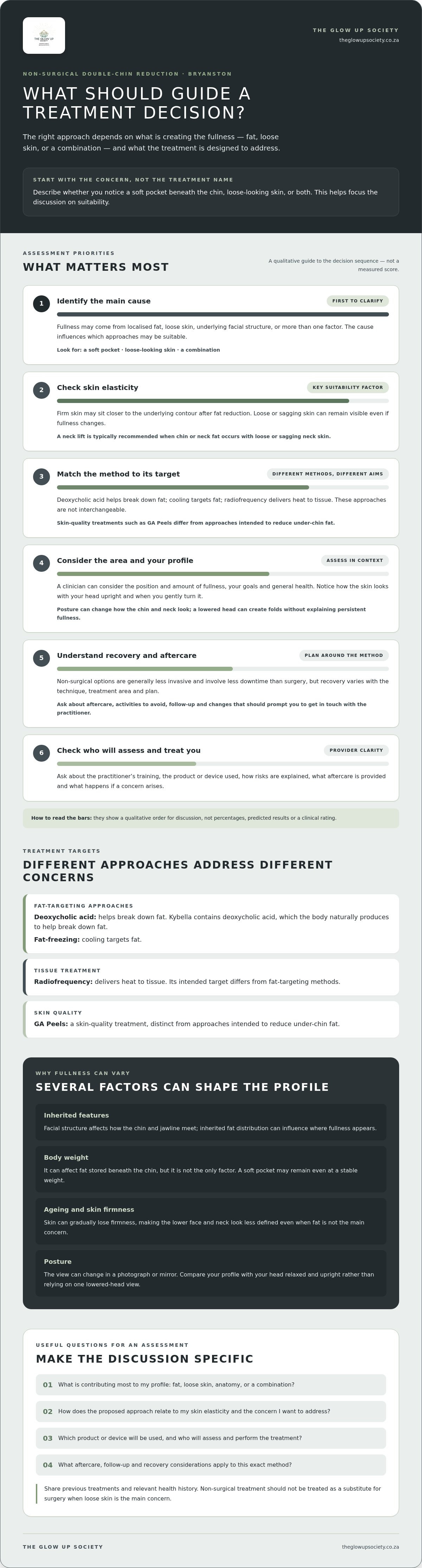
Skin elasticity affects how the area beneath your chin may look after fat reduction. If skin remains firm, it may sit closer to the underlying contour; loose or sagging skin can remain visible even if fullness changes. Suitability depends on whether fat, loose skin or both contribute to your profile. A neck lift is typically recommended for people with chin or neck fat and loose or sagging skin around the neck.
During an assessment, notice how the skin looks with your head upright and when you gently turn it. A clinician can consider skin laxity alongside the position and amount of under-chin fullness, your goals and general health. This helps distinguish localised fat from concerns where excess skin is prominent. Non-surgical treatment should not be treated as a substitute for surgery when loose skin is the main concern.
Deoxycholic acid injections, fat-freezing and radiofrequency work differently: the acid helps break down fat, cooling targets fat, and radiofrequency delivers heat to tissue. Kybella contains deoxycholic acid, which the body naturally produces to help break down fat. These approaches are not interchangeable, so suitability depends on the area being treated and the method’s intended target.
When considering a Bryanston provider, ask who will assess and perform the treatment, what training they have, and which product or device they use. Ask how risks are explained, what aftercare is provided and what steps are taken if a concern arises. Clear information about the proposed treatment helps you make an informed choice.
Skin cancer excision and reconstruction are a separate clinical context, not cosmetic double-chin treatments. Reconstructive surgery aims to repair the breast, skin, limbs, lymphatic system, and head and neck after trauma, infection or cancer. If an excision affects the head or neck, reconstruction addresses the resulting tissue defect and is separate from aesthetic fat reduction.
For a practical discussion about suitability, describe what bothers you most: a soft pocket beneath the chin, loose-looking skin, or both. Mention previous treatments and relevant health history, then ask how the proposed approach relates to your skin elasticity. This focused conversation can clarify whether non-surgical treatment matches your concern or another approach is more appropriate.
Causes of a double chin
Fullness beneath the chin can have several causes. Inherited facial structure affects how the chin and jawline meet, while inherited fat distribution influences where fullness appears. Even at a stable weight, a person may have a soft pocket beneath the chin. Body weight can also affect fat stored there, but it is not the only factor. For non-surgical double chin reduction in Bryanston, identifying the main cause helps guide a relevant treatment discussion.
Ageing can change the lower face and neck as skin gradually loses firmness. The area may look less defined even when fat is not the main concern. A fuller profile can reflect localised fat, loose skin, underlying anatomy or a combination. Distinguishing these features helps establish whether a fat-targeting approach fits your concern.
Posture can change how your chin and neck look in a photograph or mirror. Lowering your head, for example, can create folds beneath the chin, but that view alone does not explain persistent fullness. Compare your profile with your head relaxed and upright, and note whether the area looks soft, loose or consistently prominent.
When considering clinics in Bryanston and nearby areas, look for aesthetic or medical clinics that assess under-chin concerns and explain their treatments. For non-surgical double chin reduction in Bryanston, focus on whether the proposed approach addresses fat, skin or both, rather than relying on the treatment name alone.
A consultation gives the practitioner an opportunity to discuss your concern, health history and treatment suitability. Financing is a separate payment arrangement, not a treatment outcome. Consider it only when the clinic provides clear terms. Do not assume a consultation is free or that payment plans are available.
Before deciding, describe what you notice in practical terms, such as fullness that remains when you stand upright or loose skin that shows when you turn your head. These details keep the discussion centred on your concern and help you understand whether the suggested approach is relevant.
Recovery times
Non-surgical options such as Kybella are typically less invasive and involve less downtime than surgical liposuction or a neck lift. This does not mean every non-surgical method has the same recovery experience. The technique, treatment area and your plan all influence what to expect afterwards.
The number of sessions depends on the method, the amount of fullness being addressed and how the area responds between appointments. A treatment plan should explain the intended sequence and when progress will be reviewed. Ask how follow-up fits into the plan before arranging appointments around work, travel or social commitments.
Expected results depend on what the treatment targets. An approach aimed at under-chin fat may change fullness, while a procedure that addresses loose skin has a different purpose. Results and how long they last depend on the method, the change achieved and factors such as later weight changes or natural ageing. Compare profile photographs taken in similar lighting and posture to track contour over time.
For a useful recovery discussion, ask the practitioner to explain aftercare for the exact method proposed. Clarify which activities to avoid, how to care for the treated area and what changes should prompt follow-up. Keep the instructions in writing. If you are comparing a non-surgical option with surgery, ask how recovery could affect your usual routine and care arrangements.
Plan around the treatment, rather than a generic downtime estimate. For example, avoid scheduling an important event immediately after an appointment until you understand the aftercare guidance. Keep follow-up appointments and share new concerns with the practitioner. These steps help you follow the treatment plan and assess changes consistently.
During a review, discuss whether the change matches your original goal, such as reducing a soft pocket beneath the chin or creating a clearer profile. If loose skin is your main concern, ask how it affects the intended result. Comparing the initial assessment, treatment approach and follow-up observations gives you a clearer picture of progress.
What non-surgical double chin reduction treatments are available in Bryanston, South Africa?
Options discussed for under-chin fullness include deoxycholic acid injections, fat-freezing and radiofrequency. They target tissue differently, so the treatment name alone does not show whether it suits your concern. An assessment should first establish whether the main issue is localised fat, loose skin or both.
Kybella contains deoxycholic acid, which the body naturally produces to help break down fat. The treatment is intended to target fat beneath the chin. Fat-freezing uses controlled cooling to target fat cells, while radiofrequency uses energy to heat tissue. These methods work differently and should not be treated as interchangeable choices.
Ask what the proposed method is designed to change, what the treatment involves and what recovery may look like. For example, if loose skin is your main concern, a fat-targeting method may not address it. A neck lift is typically recommended for people with chin or neck fat and loose or sagging skin around the neck.
In Bryanston, discuss the exact treatment and device with the practitioner instead of assuming every clinic offers every method. Ask who performs the procedure, how suitability is assessed, what risks are explained and what aftercare is provided. These details help you compare options by safety and relevance, not just a promised contour change.
Skin-focused treatments are a separate category from procedures intended to reduce under-chin fat. They may suit goals centred on skin appearance, but they shouldn’t be presented as a way to dissolve fat beneath the chin. If your concern is texture or overall skin condition, you can explore skin-care treatment options as a distinct part of your routine.
Before choosing, write down your main goal and the change you hope to see. Then ask how the suggested method relates to that goal, whether it addresses fat or skin, and how progress will be reviewed. This simple comparison helps align expectations with the treatment’s purpose.
The Glow Up Society: GA Peels
The Glow Up Society offers GA Peels for people whose interests also include professional skin care. A peel is a skin-focused treatment, not a procedure for reducing fat beneath the chin, so it serves a different goal from double-chin treatments. If you are exploring skin care alongside concerns about chin fullness, ask about options that fit your priorities.
The clinic also offers LHA Peels, Retinol Peels and Optiphi Microneedling. These skin treatments can be discussed in relation to your skin-care needs. Keeping the distinction clear can help you choose an approach that matches the change you want, whether it relates to skin care or under-chin contour.
For a calm discussion of GA Peels and related skin treatments, contact The Glow Up Society.
Choose a next step that fits your goals
For non-surgical double chin reduction in Bryanston, start with a clear conversation about the change you want and the approach designed to address it. Keep skin care and under-chin fat reduction distinct: a peel is not a treatment for reducing fat beneath the chin.
If skin care is also part of your personal goals, The Glow Up Society offers GA Peels, LHA Peels and Retinol Peels. These options address skin-focused needs rather than serving as substitutes for a treatment targeting chin fullness. A considered plan starts with clarity about what matters to you and which concern you want to address first.
Take time to explain your priorities and understand how a proposed treatment relates to them. Contact The Glow Up Society to discuss your skin-care goals and explore a thoughtful next step.
Frequently Asked Questions
Who is a suitable candidate for non-surgical double chin reduction?
A suitable candidate is someone whose main concern is localised fullness beneath the chin and whose goals match what the chosen treatment is designed to address. During assessment, discuss your health history, previous procedures and any medicines you use. Bring a clear example of the profile change you hope to see. If excess skin is your primary concern, ask how it affects the options being considered.
What are the risks, side effects, and recovery time for double chin reduction treatments?
Risks, side effects and recovery vary by method, so ask for details about the exact treatment proposed before deciding. Request an explanation of expected after-effects, aftercare, activity guidance and signs that need prompt follow-up. Non-surgical options are typically less invasive and involve less downtime than liposuction or a neck lift, but that comparison does not describe the recovery for every individual method.