Skincare
Medical weight management in Fourways: care and blood tests
· The Glow Up Society

Blood tests aren’t required for everyone seeking medical weight management. A medical weight management protocol in Fourways may include investigations if your health history, symptoms or examination suggest they could be useful. The aim is to understand your needs, not to make testing automatic.
It’s understandable to want clarity about what an assessment involves and whether blood tests may be part of it. This article explains how health assessment, lifestyle support and progress monitoring can work together, and what may influence a decision to investigate further. Follow-up can review your response, how well you tolerate the approach and whether it remains suitable over time. An individual plan can make the process clearer and more manageable, with each step guided by your health and goals.
Key Takeaways
- Understand how nutrition, movement and behaviour support can form part of a sustainable weight-management approach.
- Learn why blood tests may be considered in light of your health history, symptoms and examination, rather than being automatic.
- See why prescription treatment is not suitable for everyone and what follow-up can review during care.
- Explore how obesity management can take a long-term, individualised approach that looks beyond personal discipline.
Table of Contents
- Nutrition, movement and lifestyle support
- When blood tests may be considered
- What are the risks, side effects and contraindications of medical weight loss treatments?
- Obesity management
- The Glow Up Society: Medical weight management
Nutrition, movement and lifestyle support
In South Africa, weight support may combine nutrition therapy, movement and behaviour changes. These elements work together rather than treating food choices as isolated tests. Your routine, preferences, health and barriers shape practical recommendations. A considered plan can bring these areas together, for example by planning meals around familiar foods and a manageable schedule. Specific choices should suit your circumstances, not follow a rigid template.
Nutrition therapy explores what, when and where you eat, alongside hunger cues. A useful first step is mapping a typical day, including meals, snacks and drinks. This can reveal patterns such as rushed lunches or evening grazing. Support can then focus on one change, such as preparing lunch before work. Progress is easier to discuss when a change is clear and repeatable. Advice should account for cultural foods and household routines.
Physical activity is another part of lifestyle support, adapted to your ability and routine. A discussion can identify suitable movement rather than impose a one-size-fits-all target. For example, a short walk after a meal may fit your local routine, while someone with joint discomfort may need a different starting activity. Movement can also include everyday choices, such as taking the stairs or walking to run errands. Comfort, access and consistency matter when choosing an approach.
Behaviour support connects these choices with the circumstances that shape them. Work demands, sleep routines, stress and social meals can all affect daily patterns. One goal might be preparing lunch, then reviewing what helped. That makes adjustments specific: change the timing, food option or routine. Small, trackable actions give follow-up discussions something concrete to assess.
South Africa’s obesity strategy sets a prevention and management framework for 2023-2028. It provides national context, while personal support focuses on your daily choices. Follow-up can revisit meal patterns, movement and barriers. If a routine proves difficult, refine it rather than blame yourself. That approach keeps nutrition therapy and physical activity connected to real life.
South Africa’s National Food and Nutrition Security Plan covered the period 2018 - 2023, adding another policy reference alongside the obesity strategy. These national plans provide context for nutrition support, while practical decisions still depend on individual routines, preferences and barriers. Keeping that distinction clear can help make day-to-day goals relevant and manageable.
When blood tests may be considered
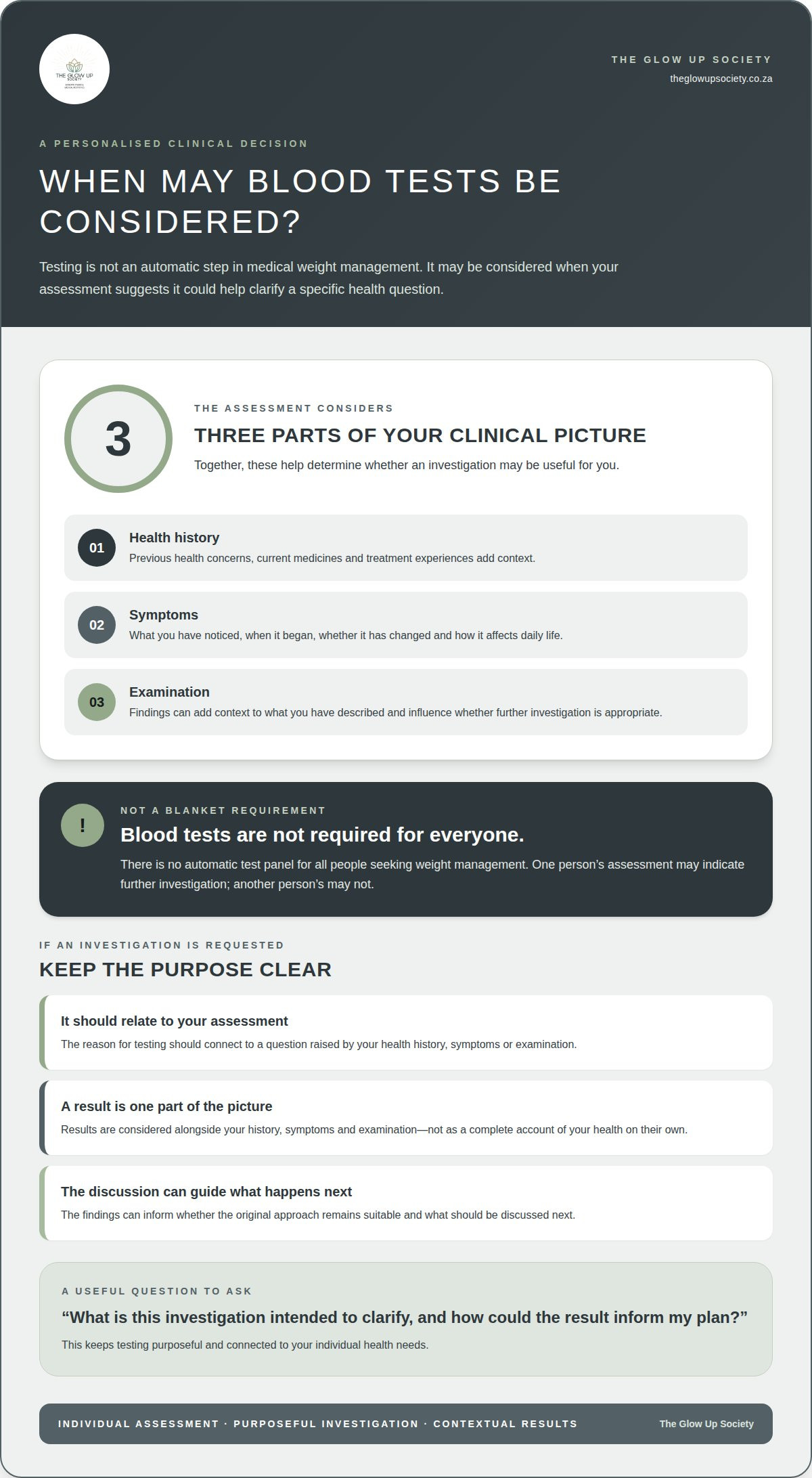
Blood tests aren’t required for everyone seeking weight management. An assessment considers your health history, symptoms and examination before deciding whether investigations may help. The key question is what needs to be clarified. Testing is not an automatic step or a standard panel for everyone. For example, a symptom raised during a consultation may prompt further investigation, while another person’s assessment may not indicate the same need.
Your health history provides context for that decision. Previous health concerns, current symptoms and medicines can shape which questions need attention. A clinician may ask when a symptom began, whether it has changed and how it affects daily life. These details connect an investigation to a specific clinical question. They also help ensure a blood result isn’t treated as a complete account of your health.
The examination matters too. Findings can add context to what you’ve described and influence whether further investigations are appropriate. A discussion about your symptoms, for instance, may lead to a different decision from an examination without relevant findings. Blood tests are one possible part of a wider assessment, not a substitute for discussing your health and concerns.
If investigations are requested, their purpose should relate to your assessment. They inform care rather than determine your weight-management needs in isolation. Results need to be considered alongside your history, symptoms and examination. This context can guide the next discussion, including whether the original approach remains suitable. A clear explanation of what a test is intended to assess can help you understand how its result fits into your care.
In short, the decision depends on the clinical picture, not a blanket requirement. Ask what question an investigation is intended to answer and how its result may inform the plan. This keeps testing purposeful and connected to your health, rather than making it a routine hurdle before support can begin.
The decision can vary from person to person. Investigations are considered in light of each person’s history, symptoms and examination, rather than treated as a universal requirement.
What are the risks, side effects and contraindications of medical weight loss treatments?
Prescription treatment for weight management isn’t automatic or suitable for everyone. Possible benefits and risks depend on the treatment and your health circumstances. Side effects and contraindications are specific to each medicine, so they shouldn’t be assumed to apply equally across all options. An assessment considers whether a treatment is appropriate before it becomes part of a plan.
Your health history helps identify factors that could affect suitability. Relevant details include current medicines, previous treatment experiences, existing health conditions and new symptoms. For example, a medicine you already use for another condition could affect the overall treatment decision. Sharing these details gives a clearer picture of potential risks and helps provide context for discussing what to expect from a proposed approach.
Side effects need to be considered in relation to the chosen treatment. A symptom that begins after treatment starts is useful information for follow-up, not something to dismiss. Note what changed and when, then raise it during review. The same applies if a symptom becomes more troublesome or affects daily activities. This helps assess tolerability alongside treatment response.
Follow-up should review treatment response, tolerability, adherence, new symptoms and whether the original approach remains appropriate. These checks connect safety with progress. For instance, limited benefit or a new concern can prompt a fresh discussion about continuing the same plan. Any change should reflect the updated assessment, rather than an assumption that every treatment suits everyone.
Before starting prescription treatment, discuss its intended role, possible side effects and relevant precautions. Ask which symptoms to report and how they may affect the next review. If a new symptom appears during treatment, share it promptly through the appropriate care channel. Clear communication supports informed decisions and helps keep the plan aligned with your health, response and comfort.
Potential concerns vary by medicine and individual health circumstances. Suitability is assessed in light of health conditions, current medicines, previous treatment and symptoms. New or worsening symptoms should be reported and reviewed alongside treatment response and tolerability.
Obesity management
Obesity is a complex, chronic and relapsing disease, not a failure of personal discipline, as the World Health Organization describes it. In South Africa, 41.3% of women and 15.3% of men live with obesity. These figures underline why care should consider health and circumstances, rather than rely on blame or assumptions about motivation. A medical weight management protocol in Fourways can be one route to individualised support.
Biology can also contribute: genes can account for up to 70% of obesity. This is one reason weight management cannot be reduced to willpower alone. A useful assessment considers the wider health picture and factors that shape a person’s experience. The South African National Clinical Practice Guideline for the Management of Obesity in Adults was released in October 2025, providing a local clinical reference for adult care.
Management may combine investigations, behaviour support and prescription treatment where indicated. The right combination depends on the person’s needs and circumstances. The World Health Organization describes weight-management medicines as one possible part of comprehensive, longer-term care for appropriately selected adults, not a stand-alone solution. Medication can be one part of a wider plan alongside other forms of support.
For some adults, metabolic bariatric surgery may be considered under the South African guideline. People living with obesity with a BMI greater than 35 kg/m2 qualify under the guideline. Those with a BMI of 30-34.9 kg/m2 and qualifying co-morbidities may also qualify. These criteria identify when surgery may be an option, rather than a recommendation for everyone. Surgery combined with healthy behaviours can lead to long-term weight loss of 20-40% of body weight.
Obesity management therefore has several possible pathways, from investigations and behaviour support to prescription treatment or surgery. Each addresses a different part of care. A considered conversation can help clarify which approach fits your health needs and priorities. Explore available care options as you consider your next step.
The Glow Up Society: Medical weight management
The Glow Up Society offers medical weight management for people seeking structured support with weight-related goals. It may suit you if you want to discuss how assessment, lifestyle support and progress monitoring could work together. An assessment can clarify what may be considered, including whether investigations or prescription treatment are appropriate for your circumstances.
At The Glow Up Society, medical weight management sits alongside skin services such as GA Peels, LHA Peels and Retinol Peels. These address different needs, so the right conversation depends on the support you’re looking for. If you’re ready to explore medical weight management, contact The Glow Up Society.
Take a considered next step
Use what you’ve learned to shape a conversation around the support you want. A medical weight management protocol in Fourways can be a starting point for discussing your priorities, questions and preferred pace. You don’t need to have every answer before taking that step. A clear sense of what matters to you is enough to begin.
At The Glow Up Society in Fourways, medical weight management offers a way to explore support focused on your needs. You can raise questions about the process and discuss what you hope to achieve. This first conversation can help you decide whether to continue and what you’d like to understand next.
Choosing to seek support is a personal decision. Take the time you need, and start when you feel ready. Contact The Glow Up Society to begin a conversation about your options.
Frequently Asked Questions
Are blood tests always required?
No. Blood tests aren’t required for everyone starting medical weight management. An assessment may identify a symptom or health concern that makes an investigation useful, while another person may not need one. The decision relates to the clinical question being considered. You can ask what a proposed test is intended to clarify and how its result could inform your care.
What assessments and tests are required before starting a medical weight loss programme?
There isn’t one set of tests required for everyone. An assessment may include a discussion of your health history, current symptoms and medicines, alongside an examination. For example, mention a medicine you take for another condition, as it may affect the treatment discussion. Blood tests may be considered if the overall assessment points to a reason for further investigation.