Skincare
InBody Test vs Smart Scales: How Accurate Is Body Fat Data
· The Glow Up Society
A smart scale can track your weight more reliably than it estimates your body fat. For InBody test versus smart scales, accuracy depends on what you’re measuring: an InBody scan captures a fuller picture of body composition, but it isn’t perfectly precise either. Hydration, recent exercise and measurement conditions can shift both readings.
If your body-fat percentage changes from one morning to the next, that doesn’t necessarily mean your body has changed. Home scales are useful for tracking weight, but their body-composition figures are best treated as broad signals, not exact measurements.
This guide compares smart-scale estimates with InBody scans, explains why readings can vary from day to day, and shows how consistent testing conditions make trends easier to interpret. You’ll also learn when professional body-composition testing may offer a more detailed checkpoint and what the results can and can’t tell you. The aim is a calmer, more useful way to understand progress without letting one number define it.
Key Takeaways
- Use a smart scale mainly to follow weight patterns; treat its body-fat figure as an estimate, not a precise measurement.
- For clearer comparisons, keep measurement conditions consistent and look at trends rather than isolated readings.
- Choose an InBody scan when you want a more detailed view of body composition, while remembering that it is not a diagnosis.
- The Glow Up Society’s InBody 270 analysis can provide a professional body-composition checkpoint to support your wellness goals.
Table of Contents
- How accurate are smart scales for body fat?
- InBody scan accuracy compared with other body composition methods
- When professional body-composition testing is useful
- Smart-scale day-to-day variability
- The Glow Up Society: Inbody 270 body composition analysis
How accurate are smart scales for body fat?
Smart scales generally measure total weight more reliably than body-fat percentage. Understanding InBody test vs smart scales accuracy means comparing how each device estimates body composition, rather than treating either result as exact.
Bioelectrical impedance in body composition
Bioelectrical impedance analysis sends a low-level electrical current through the body and measures the resistance, or impedance, it encounters. The device uses that reading to estimate body composition, including body fat and water. Because water conducts electricity differently from fat, hydration can affect the calculation. The result is an estimate, not a direct measurement of fat tissue.
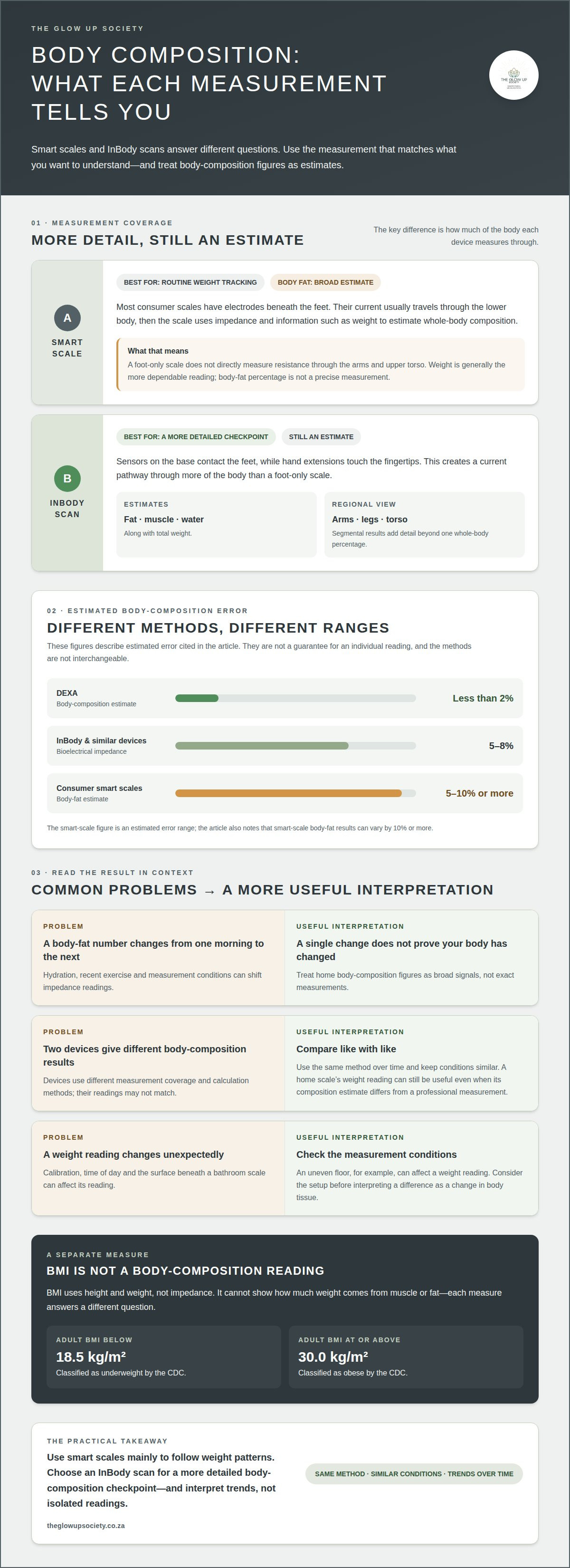
For context, the Centers for Disease Control and Prevention classifies an adult BMI below 18.5 kilograms per square metre as underweight, and 30.0 kilograms per square metre and above as obese. BMI uses height and weight, not impedance, so it cannot show how much weight comes from muscle or fat. Each measure answers a different question.
InBody impedance analysis
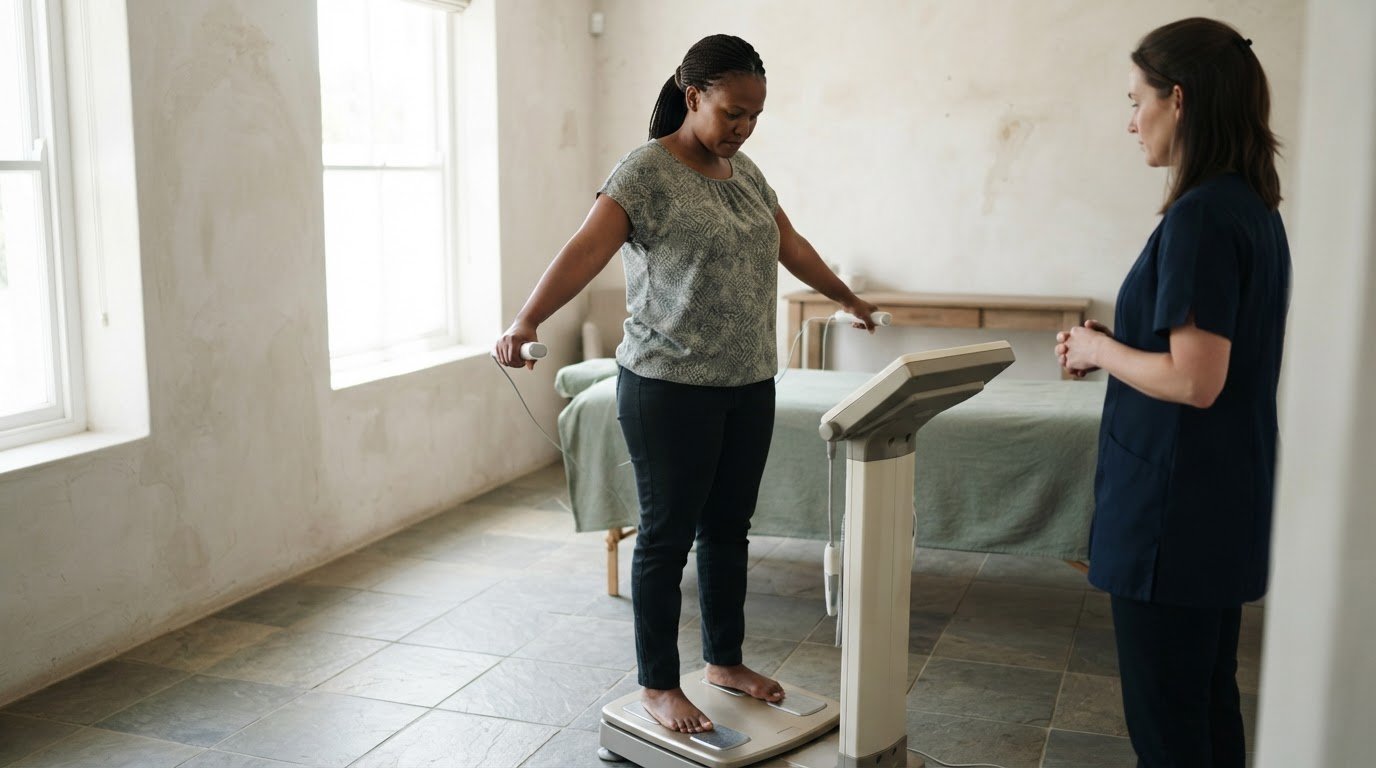
An InBody scan uses a low-level electrical current and measures resistance to estimate body composition. Sensors on the base contact the feet, while hand extensions touch the fingertips. This creates a current pathway through more of the body than a foot-only scale can measure. The scan estimates fat, muscle and water in the arms, legs and torso, as well as total weight.
InBody bioelectrical impedance analysis still involves estimation. The estimated body-composition error for InBody and similar devices is 5-8%. This helps frame what a reading can offer: more detail than a basic bathroom scale, but not a perfect account of physical tissue. The InBody test vs smart scales accuracy comparison depends partly on this difference in measurement coverage.
Segmental multi-frequency measurements
Segmental measurement divides the body into regions, such as each arm, each leg and the torso, rather than treating it as one uniform shape. Multi-frequency analysis uses currents at different frequencies to assess variations in impedance. Together, these methods help an InBody scan estimate regional composition, providing more detail than a single whole-body percentage.
Regional results can help you interpret changes in different areas instead of relying only on one total body-fat figure. However, they are still calculated estimates. Scan comparisons are most useful when you use the same device under similar conditions, because hydration can shift impedance across body segments.
Smart-scale impedance measurements
Most consumer smart scales use electrodes beneath the feet, so their electrical current usually travels through the lower body. The scale combines that impedance reading with information such as weight to estimate whole-body composition. A foot-only scale does not directly measure resistance through the arms and upper torso, unlike an InBody device with hand sensors.
Consumer bioelectrical impedance scales can have body-fat errors of 5-10% or more. A study of three home smart scales found better agreement for weight than body composition. For daily use, weight is generally the more dependable reading; treat body-fat percentage as a broad signal, not an exact physical measurement.
InBody scan accuracy compared with other body composition methods
Different methods assess body composition in different ways, so their readings may not match. The InBody test vs smart scales accuracy comparison is most useful when you consider whether you need routine tracking or a more detailed estimate.
Smart scales and professional measurements
Smart scales make frequent home readings convenient, while professional measurements can provide a more detailed body-composition assessment. Neither result is an exact account of every tissue. Smart-scale body-fat results can vary by 10% or more, so one reading may not show a meaningful change in muscle mass or fat.
For tracking, compare results from the same method over time. A home scale’s weight reading may still be useful even when its composition estimate differs from a professional measurement. Weight is measured directly; body composition is calculated. This distinction helps you choose the reading that best suits your goal.
InBody scans and bathroom scales
A bathroom scale measures total weight, while an InBody scan estimates how that weight is distributed across body composition. InBody and similar bioelectrical impedance devices have an estimated body-composition error of 5-8%. Their added detail can help you explore composition, but the result is not a definitive measure of fat or muscle.
Bathroom-scale readings can also vary with calibration, error tolerance, time of day and the surface beneath the device. An uneven floor, for example, can affect a weight reading. Consider these conditions before interpreting a difference as a change in body tissue.
Comparing InBody, DEXA and smart scales
DEXA, InBody and smart scales produce estimates with different levels of detail and error. DEXA scan accuracy is listed as an error of less than 2%, compared with an estimated 5-8% for InBody and similar impedance devices. Smart-scale body-fat results can vary by 10% or more.
These comparisons don’t make results interchangeable. DEXA can provide a more reliable body-fat measure than BMI alone, while a smart scale supports convenient routine tracking. Choose according to the question you want the measurement to answer.
InBody accuracy against DXA
InBody results may differ from DXA because the methods estimate body fat differently. InBody scans underestimate body fat in adults by 1.0-4.8%, and overestimate it in children by 0.3-2.3%. The InBody test vs smart scales accuracy question is separate from agreement with DXA, so interpret each comparison within its own context.
For ongoing tracking, compare results from the same method rather than treating one scan as a correction for another. If you want a more detailed checkpoint, an InBody 270 body composition analysis can provide a structured view of your composition.
When professional body-composition testing is useful
What factors affect InBody and smart-scale accuracy? Salt, alcohol, carbohydrate intake, fluid intake and recent exercise can shift body-water distribution and change calculated body-fat, muscle and water estimates. Age is another limitation: commercial body-composition scales cannot account for a person’s age. These factors explain why a reading may change even when your longer-term progress has not.
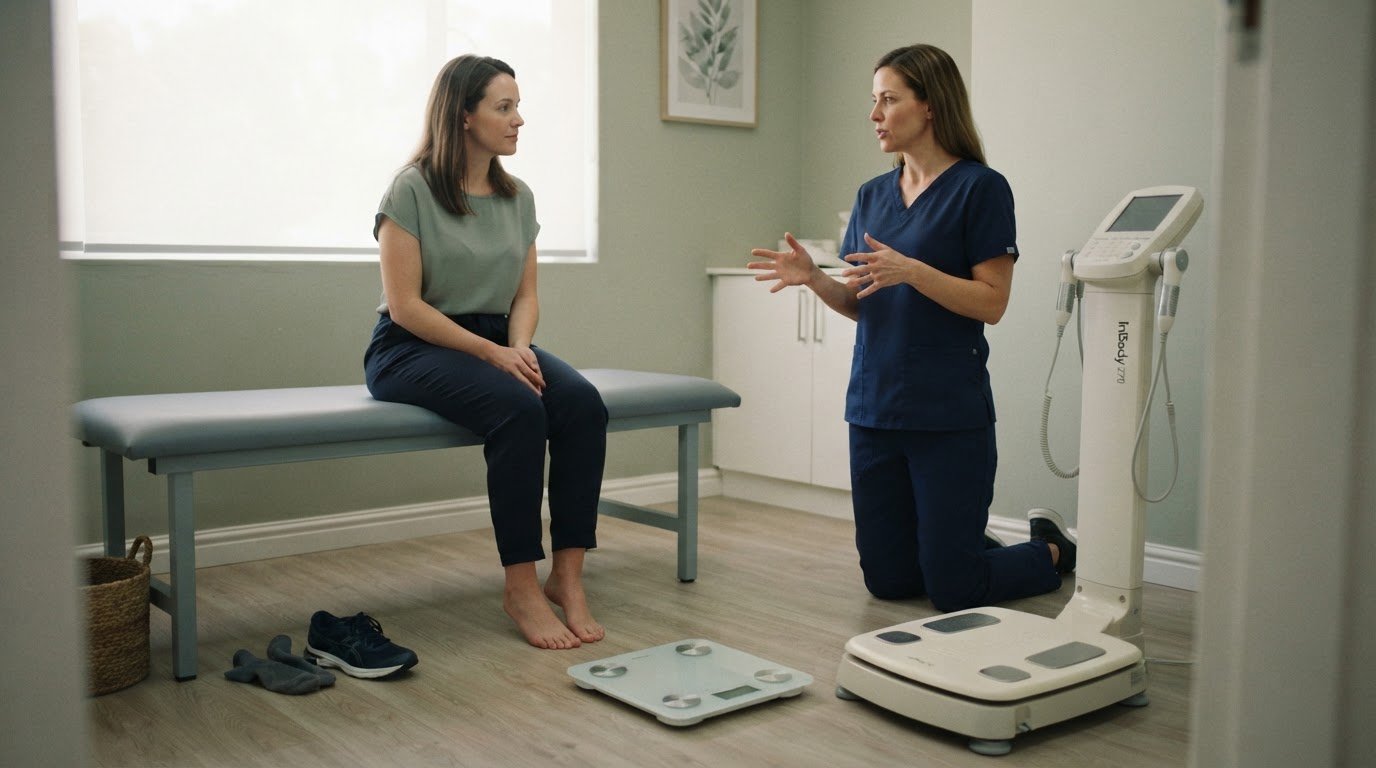
A professional InBody scan is useful when you want a more detailed body-composition checkpoint than weight alone can provide. For clearer comparisons, scans should take place under similar conditions each time. Avoid eating or exercising for a few hours beforehand, and use the same device for later measurements. This makes the pattern easier to interpret than comparing results from different machines or routines.
For regular tracking, a home scale suits frequent weight checks, while an InBody scan can provide a more detailed checkpoint every few weeks. Take home readings at the same time of day, ideally in the morning after using the bathroom and before eating. Treat body-fat percentage, muscle, body-water and metabolic-age figures as directional signals, not precise measures. A change in hydration, for example, may shift those estimates without reflecting a lasting change in body composition.
Fitness progress doesn’t always show up as a lower number on the scale. Gaining muscle through exercise can increase your weight while your physique and overall health improve. A body-composition reading may help you notice changes beyond weight, but an InBody test is not a diagnosis or a complete medical assessment. Evidence about using body-scan data in clinical practice, and its effect on long-term health, remains limited.
Use results as one part of a wider view of wellbeing. Blood pressure, cholesterol and fasting blood sugar are established markers to monitor and improve for chronic disease prevention. Pairing consistent body-composition tracking with these measures gives a more balanced picture than focusing on one estimate alone.
Smart-scale day-to-day variability
A smart scale can show a different body-fat percentage from one day to the next, even without a meaningful change in body tissue. Bioelectrical impedance estimates composition by measuring the resistance an electrical current meets as it passes through the body. Changes in body water can alter that resistance and shift the calculated percentage.
Small differences in how you stand can also affect a reading. Foot size and width, foot placement and changes in body position influence contact with the scale’s electrodes. If you move before the device finishes measuring, it may produce an error or leave data missing. A reading taken with your heels positioned differently may therefore be less comparable than it appears.
For steadier comparisons, use the same scale at the same time each day. Morning readings, after using the bathroom and before eating, provide a more consistent routine. Keep your feet in a similar position and stand still until the display completes its analysis. These habits won’t make the estimate exact, but they help reduce avoidable variation.
Consider what the number is telling you. A change in body-fat percentage may reflect altered hydration or electrode contact, rather than a clear change in fat or muscle. Smart scales are more useful for frequent weight tracking; body-fat, muscle and water estimates are directional signals. Look for a sustained pattern across comparable readings instead of reacting to one result.
InBody readings can also differ when conditions change, and the same person can receive significantly different results hours apart. For either method, compare measurements taken under similar conditions and on the same device. A home scale can support regular weight tracking, while professional testing offers a more detailed checkpoint. Explore a more detailed body-composition assessment when you want to compare broader trends.
The Glow Up Society: Inbody 270 body composition analysis
The Glow Up Society offers InBody 270 body composition analysis for a more detailed view of body-composition trends than a home scale’s estimates alone. It can be useful when you want a professional checkpoint to complement routine weight tracking or to understand changes in muscle, fat and water. Like other bioelectrical impedance readings, results can shift with hydration, food and recent exercise, so comparing scans under similar conditions gives trends more context.
Use the results as an informative snapshot, not a diagnosis or a measure of your worth. If you’re considering body-composition testing as part of your wellness goals, contact The Glow Up Society to discuss the InBody 270 analysis.
Choose a next step that suits your goals
Body-composition data is most useful when it supports a decision you care about, rather than becoming another number to chase. Choose what you want to understand next, such as changes in strength, how your clothing feels, or whether your routine feels sustainable. Let that aim guide how you use future readings, and give greater weight to patterns than to isolated results.
Understanding the accuracy of an InBody test versus smart scales can help you set sensible expectations, but the right measure depends on the question you want answered. If you’d like a professional composition check-in, contact The Glow Up Society. Its wider personal-care offering also includes GA, LHA and retinol peels for those with separate skin-care goals.
Contact The Glow Up Society to discuss your next step. A thoughtful approach can help you feel more at ease with your progress.
Frequently Asked Questions
Does Accuracy Vary by Age and Sex?
Age is a known limitation: commercial body-composition scales cannot account for a person’s age. A displayed percentage is not an age-adjusted clinical assessment, and a sex label alone cannot validate its accuracy. For example, two adults with the same height and weight may have different muscle-to-fat proportions. Treat the scale’s result as an estimate, not a definitive assessment of your body composition.
What are the pros and cons of body fat scales?
Body-fat scales offer a quick reading at home and make regular weighing convenient. However, their body-fat and muscle figures are calculated estimates, not direct measurements of tissue. If the display shows a sudden composition shift after an unusual day, don’t interpret it on its own as muscle loss or fat gain. These devices suit broad self-monitoring, not diagnosis.
How accurate are smart scales for body fat and muscle measurements?
Smart scales estimate body fat and muscle, but neither figure is a direct measurement of tissue. If your weight stays stable while the display reports a change in muscle, treat that as a reason to consider the wider pattern, not proof that your muscle mass changed overnight. A scale’s composition estimates can help you notice possible trends, but they cannot confirm what caused them.
Can smart scales accurately track body fat changes over time?
They can suggest a broad direction, but shouldn’t be relied on to quantify an exact change in body fat. A simple log of the date, weight, estimated percentage and relevant context, such as a change in training, can make readings easier to interpret. Compare a series of results rather than two isolated points, so an app graph doesn’t turn ordinary fluctuations into assumed progress.
How should you prepare for an InBody test or smart scale measurement?
For an InBody test, avoid eating or exercising for a few hours beforehand. At home, place your scale on a firm, level surface, take the reading after using the bathroom and before breakfast, and remain still until it finishes. Keep your usual routine rather than deliberately changing your food or fluid intake. If you’re in Fourways or nearby, a professional InBody assessment can provide a structured comparison.