Skincare
How to Prepare for a Chemical Peel: A Calm, Clear Checklist
· The Glow Up Society

Good chemical peel preparation isn’t about following a long, universal checklist. The right steps depend on your skin, your current routine and the peel planned, so advice that suits one person may not suit another. A little preparation can still make your appointment clearer and more comfortable.
If you’re unsure which skincare products to pause, or whether recent sun exposure or sensitivity could affect your treatment, make a note of it before your appointment. Share what you use on your skin, any recent changes or reactions, and anything else relevant to your skin’s condition. This gives your skincare professional useful context for discussing a plan that fits you.
This guide offers a practical checklist for chemical peel preparation. You’ll learn what to discuss before treatment, how to review products and sun exposure, and why preparation can vary between peels. At The Glow Up Society in Fourways, GA, LHA and retinol peels are tailored to individual skin concerns, so your preparation should reflect your skin and the treatment planned.
Key Takeaways
- Make chemical peel preparation a personalised conversation about your skin, routine and planned treatment, rather than relying on a one-size-fits-all checklist.
- Prepare a clear account of skin sensitivities, previous reactions, current concerns and recent treatments to share at your appointment.
- Discuss prescription skincare, exfoliants, retinoids and waxing before changing your routine, then follow the guidance you’re given.
- On the day, follow your personal instructions and mention recent irritation, sun exposure or other changes in your skin.
- A discussion at The Glow Up Society can help guide preparation for a tailored GA, LHA or retinol peel in Fourways.
Table of Contents
- Why chemical peel preparation matters before your appointment
- What to discuss with your skincare professional before a chemical peel
- Which skincare habits should you pause before a chemical peel?
- Your chemical peel appointment-day preparation checklist
- Preparing for a tailored peel at The Glow Up Society
Why chemical peel preparation matters before your appointment
A considered peel appointment begins with a conversation about your skin and the routine you follow at home. Chemical peel preparation is not a set of steps to copy from an online checklist. It gives your skincare professional a clearer picture of your skin’s current condition, your concerns and the products or treatments that may be relevant, so they can discuss guidance suited to your planned peel.
The same routine may feel comfortable for one person but leave another experiencing dryness or sensitivity. Sharing details early can help your professional consider whether your skin is ready for the planned treatment and whether any adjustments are appropriate. Preparation supports an informed appointment, but it can’t guarantee a particular result or replace individual professional guidance.
What chemical peel preparation is designed to do
Think of preparation as a personalised routine review, not a test you need to pass. Your professional needs a clear picture of what your skin is like now and what it has recently been exposed to. Keeping to a familiar, gentle routine may help avoid unnecessary irritation before treatment, but the right approach depends on your circumstances. If general online advice conflicts with your personal instructions, follow the guidance given for your appointment.
Why preparation is not identical for every peel
The peel category and your skin’s condition shape the preparation conversation. The Glow Up Society offers GA, LHA and retinol peels, tailored to individual skin concerns. These are distinct treatment categories, so it would be misleading to assume they all call for the same routine or timing. Your professional can consider the planned peel alongside your skin history and current skincare habits, rather than asking you to follow a one-size-fits-all schedule.
For general background before discussing your own appointment, What is a Chemical Peel? offers an overview of the treatment. Use general reading as context, not as a substitute for personalised instructions. Your professional’s guidance should reflect the peel being considered and the state of your skin at the time.
- Your skin condition: Recent sensitivity or visible irritation may be relevant to the conversation.
- Your routine: Products and treatments provide useful context, even if they seem ordinary to you.
- Your planned peel: Preparation should relate to the treatment being considered, not a generic timetable.
This section focuses on the period before treatment. Recovery and aftercare involve separate guidance once your peel has taken place. For now, approach the appointment as a collaborative discussion: share what you know, mention anything that has changed, and let your professional shape preparation around your skin and planned treatment.
What to discuss with your skincare professional before a chemical peel
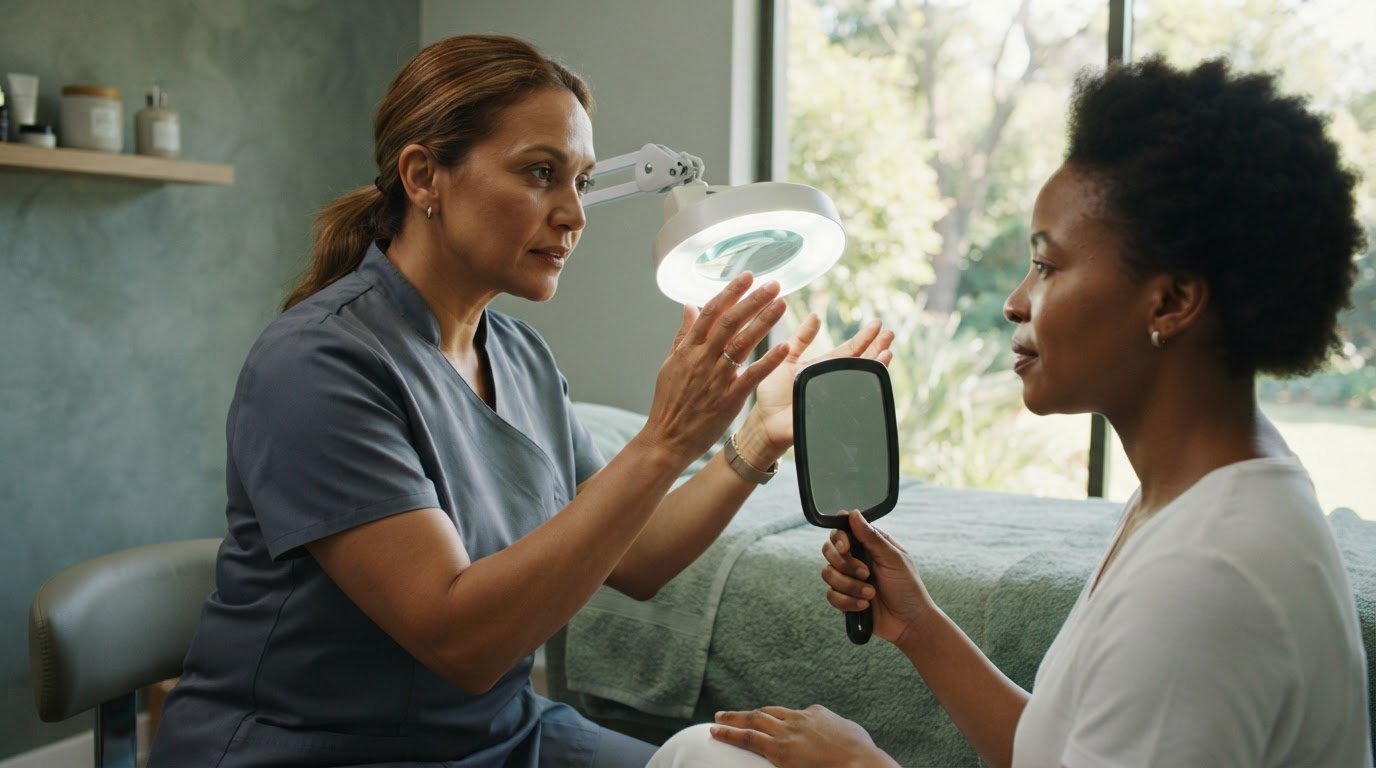
A useful consultation gives your skincare professional a fuller picture than a quick description of your main concern. Clear details about your skin history, daily routine and recent changes can help shape a preparation plan around you and the peel being considered. You don’t need to arrive with every answer. A few notes on your phone can help you remember the details that matter.
Share your skin history and current routine
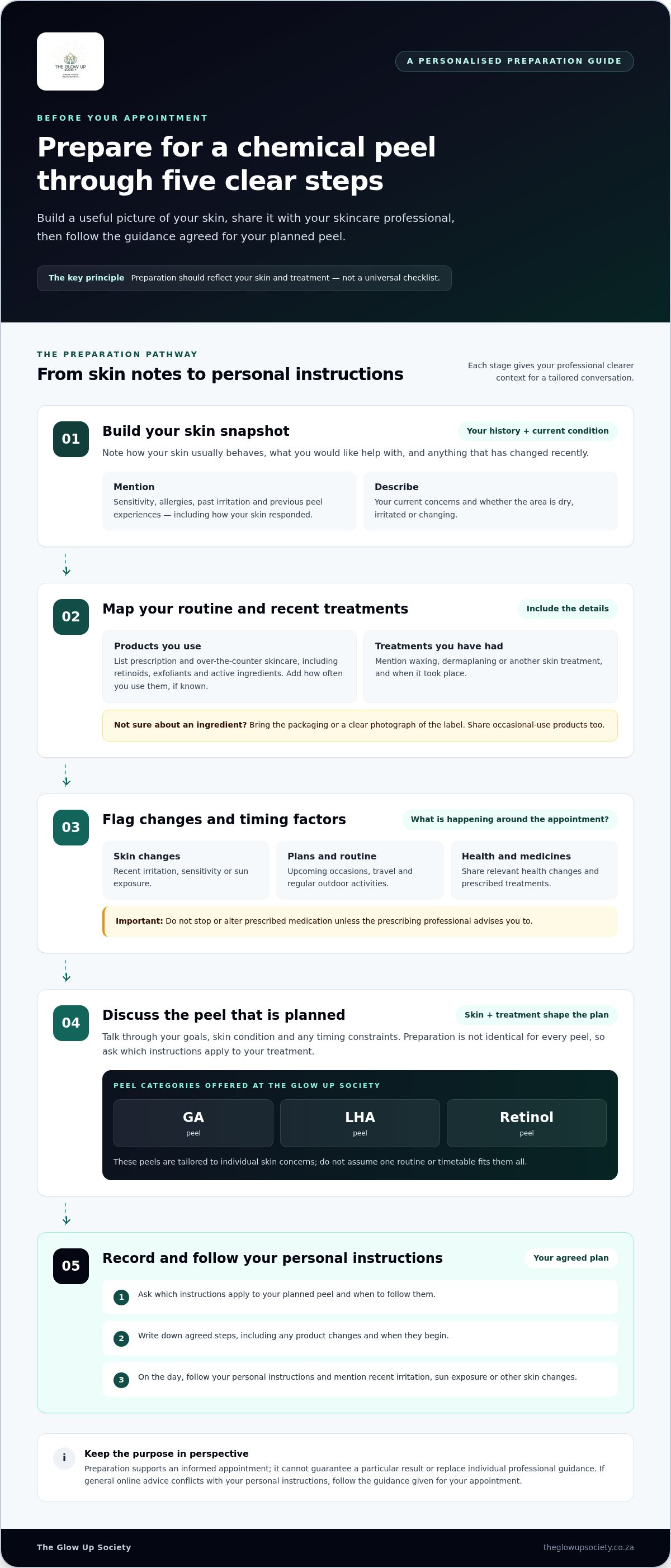
Start with how your skin usually behaves, what concerns you’d like to address and whether anything has caused a reaction before. Include sensitivities or allergies, previous peel experiences and recent changes. Then describe your routine as it is, rather than leaving out a product because you’re unsure whether it is relevant.
- Skin history: Note sensitivity, allergies, past irritation and any previous peel experience, including how your skin responded.
- Current concerns: Describe what you’d like help with and whether the area is currently dry, irritated or changing.
- Products: List prescription skincare and over-the-counter products, including retinoids, exfoliants and products with active ingredients. Include how often you use them, if you know.
- Recent treatments: Mention procedures or services such as waxing, dermaplaning or another skin treatment, and when they took place.
- Health and medicines: Share relevant health changes and medicines, including prescribed treatments. Don’t stop or alter prescribed medication unless the prescribing professional advises you to.
Even a product you use only occasionally is worth mentioning. If you’re unsure of an ingredient, bring the packaging or a clear photograph of the label. That gives your professional something specific to review instead of relying on memory.
Discuss suitability, timing and individual instructions
Your skin’s condition and your treatment goals should be considered together. Mention if your skin has become irritated or particularly sensitive, and talk through any timing constraints. A planned event, travel or regular time outdoors may affect the discussion, so share these details early rather than trying to fit your plans around a generic timeline.
- Explain what you hope to address and what matters most to you about the treatment.
- Bring up upcoming occasions, travel plans and regular outdoor activities.
- Ask which instructions apply to your planned peel and when to follow them.
- Write down the agreed steps, including any product changes and when they begin.
The American Society of Plastic Surgeons also outlines general points in Preparing for Your Chemical Peel. Use general guidance as background, then follow the instructions given for your own skin and planned treatment. If you’re considering a tailored peel, a discussion at The Glow Up Society in Fourways can help you organise your questions and share the details needed for a considered plan.
Which skincare habits should you pause before a chemical peel?
It’s tempting to stop every active product before a peel, but making several changes on your own can leave you unsure what your skin is responding to. First, share your routine and ask which adjustments, if any, apply to your planned treatment. Retinoids, exfoliating acids and hair removal are all worth mentioning, but they aren’t an automatic stop list.
Active ingredients, exfoliation and hair removal
Tell your skincare professional about products containing retinoids or exfoliating acids, such as glycolic or salicylic acid. Include how often you use them and whether they’ve caused dryness, stinging or visible irritation. The ingredients, your skin’s current condition and the peel being considered can all inform the advice you receive.
Also mention physical exfoliation, waxing and other recent skin treatments. These details help your professional consider your routine as a whole, rather than looking at one product in isolation. Don’t assume an item is harmless because you use it only occasionally, and don’t stop prescribed skincare or medicines without guidance from the professional responsible for them.
There isn’t one pause period that suits every person and peel. The American Academy of Dermatology Association’s Chemical Peel: What to Expect provides general patient information, but instructions for your appointment should reflect your skin and treatment plan.
Keep your routine calm and avoid last-minute experiments
Before treatment, keep your routine familiar instead of introducing a new serum, scrub or at-home peel. An unfamiliar product may cause a reaction or make it harder to tell what has changed in your skin. If you’re considering a new product or an intensive skin treatment, mention it before adding it to your routine.
Gentle cleansing and moisturising are useful topics to discuss, not a fixed protocol for everyone. Tell your professional what you currently use and how your skin responds. If a product feels uncomfortable or your skin becomes irritated, share that update rather than trying to correct it with more active ingredients. Your professional can advise whether your routine needs adjusting for the treatment planned.
Preparation changes should follow personalised professional advice. Write down any agreed changes and when to make them, so you don’t have to rely on memory or a generic timeline. If you’re planning a GA, LHA or retinol peel, you can discuss your routine and skin concerns as part of a tailored peel appointment at The Glow Up Society.
Your chemical peel appointment-day preparation checklist
A calm appointment-day routine starts with the instructions you’ve already discussed, not a fresh set of rules from an online checklist. Your planned peel and skin condition guide what to do. Keep the day straightforward, allow time to share any updates, and remember that this checklist is about arriving prepared, not managing recovery afterwards.
The day before: keep plans simple
Revisit your personalised instructions and note any questions that have come up. Avoid introducing new skincare products or arranging an intensive skin treatment unless your professional has advised you to do so. If you expect to spend time outdoors, such as commuting, working outside or running errands, consider how that fits with the sun-protection advice you’ve been given.
In Fourways and nearby areas such as Sandton, Lonehill, Kyalami, Bryanston and North Riding, everyday plans may include commuting, outdoor errands or time outside over the weekend. There isn’t one sun-exposure rule that applies to every peel and every person. Follow the advice provided for your treatment, and let your skincare professional know if your plans involve substantial outdoor exposure. Don’t rely on a generic timeline or make last-minute changes to your routine without guidance.
On the day: arrive ready to share updates
Before treatment begins, mention anything that has changed since your preparation discussion. Even if it seems minor, an update gives your professional a current picture of your skin and routine. If you’re unsure whether something is relevant, share it and let them guide the conversation.
- Follow your personal instructions. Keep to the steps agreed for your planned peel, rather than adding extra products or treatments.
- Keep your routine simple. Use only the skincare approach you’ve been advised to follow. Ask about cleansing or make-up rather than assuming the same rule applies to every appointment.
- Share skin changes. Mention irritation, unusual sensitivity, unexpected sun exposure or any change in your skin’s condition.
- Bring useful details. Have your product list or product photographs available, and note any medicines or routine changes discussed during preparation.
- Raise any last questions. If you’re uncertain about an instruction, clarify it before treatment starts.
These small steps make chemical peel preparation practical without turning the appointment into a test. You don’t need to arrive with perfect skin or memorise every ingredient. A clear update is more useful than trying to conceal irritation or guessing whether a change matters.
This checklist covers the time before and on the day of your appointment. Your professional will provide separate guidance for what to expect after treatment, so keep those instructions distinct from your preparation notes.
For a conversation about preparing for a tailored peel, book a peel appointment with The Glow Up Society in Fourways.
Preparing for a tailored peel at The Glow Up Society
Preparation feels more manageable when it reflects your skin and the treatment being planned, rather than a generic online schedule. At The Glow Up Society in Fourways, GA, LHA and retinol peels are tailored to individual skin concerns. Sharing a clear picture of your routine and skin history helps make the preparation conversation relevant to you.
A preparation plan shaped around your skin
Your concerns are a helpful starting point, but they’re only part of the picture. Talk through how your skin behaves, what you’d like to address and whether you’ve experienced sensitivity or reactions. Include the products you use, especially prescription skincare and active ingredients, along with any relevant treatment history. These details help inform a considered discussion about the peel and your preparation.
Prepare a few notes before your visit. You might include:
- Your current skincare products and how often you use them.
- Any sensitivities, previous reactions or recent changes in your skin.
- Recent treatments, such as waxing, exfoliation or another skin service.
- Questions about which routine instructions apply to the peel being considered.
You don’t need to work out the preparation plan on your own. Bring the information you have, including product names or photographs of labels if that’s easier. Your professional can discuss it in the context of your skin concerns and the planned treatment. Any changes to your routine should follow the instructions you receive, rather than a fixed protocol found online.
Explore chemical peels in Fourways
GA, LHA and retinol peels are offered at The Glow Up Society, with treatments tailored to individual skin concerns. This isn’t about ranking one peel above another or assuming that one category will suit everyone. It’s about having a clear conversation about your skin, your goals and your routine, then understanding the preparation relevant to the treatment being considered.
For people visiting from Fourways, Sandton, Lonehill, Kyalami, Bryanston or North Riding, everyday plans may include commuting, outdoor errands, work in the sun or time outside at the weekend. Mention these patterns as part of your discussion, particularly if they may affect how you follow the sun-protection guidance given for your appointment. There’s no need to apply a universal rule; your preparation should be based on the advice for your skin and planned peel.
A calm, informed conversation can help you arrive with a clearer sense of what to expect before treatment. You can explore the peel options offered at the Fourways clinic and take the next step at a pace that feels comfortable.
Explore chemical peels at The Glow Up Society.
Take your next step with confidence
You don’t need to arrive with every detail perfectly organised. A few notes and an open conversation can help you feel more at ease as you consider whether a peel fits your skin and goals. Let your preparation be a starting point for personalised guidance, not another source of pressure.
At The Glow Up Society, peel options are considered in relation to individual skin concerns. If you’re ready to explore what may suit your goals, take a look at the clinic’s GA, LHA and retinol peels. Your chemical peel preparation can begin with a simple next step: learning about the options and bringing your questions into the conversation.
Explore chemical peels at The Glow Up Society and move towards your appointment feeling informed and calm.
Frequently Asked Questions
Can I use retinol before a chemical peel?
Tell your skincare professional if you use retinol, whether it’s prescribed or bought over the counter, and how often you apply it. Don’t decide on your own to stop or continue close to treatment, particularly if it’s part of a prescribed routine. Your chemical peel preparation instructions should be specific to your skin and planned peel. If the retinoid is prescribed, speak with the prescribing professional before changing how you use it.
Should I avoid the sun before a chemical peel?
Tell your skincare professional about recent sun exposure, especially if you’ve developed redness, tenderness or a sunburn. There isn’t one universal instruction for every peel, so follow the sun-protection guidance given for your appointment. If you have outdoor plans, such as a long walk or a day working outside, mention them when discussing timing. Don’t conceal a change in your skin; it may affect the conversation about proceeding.
Can I wear make-up to my chemical peel appointment?
Ask the clinic what to do about make-up before your appointment, as cleansing instructions may depend on the treatment plan. If you arrive wearing make-up, let the professional know what you have applied and follow their direction before treatment begins. Avoid trying a new cleanser or make-up remover just beforehand, particularly if your skin is sensitive. The aim is to arrive comfortably, not to guess at a rule that may not apply to you.
Do I need to stop using all skincare products before a chemical peel?
No, don’t stop every product automatically. Share your routine, including cleanser, moisturiser, sunscreen, active ingredients and any prescription skincare, then follow the specific instructions you’re given. For example, a simple moisturiser you’ve used comfortably is different from an exfoliating product that may need discussion. Never change prescribed skincare or medicines without advice from the professional who prescribed them or the clinician guiding your peel preparation.
Can I have a chemical peel if my skin is irritated?
Possibly, but irritation needs to be discussed before treatment, and your skin may need to be reviewed before a decision is made. Tell your professional if you have new redness, stinging, flaking, a rash or a tender area, and mention what may have triggered it. Don’t try to cover the irritation with make-up or treat it with extra active products. Your professional can advise whether to proceed or reassess the timing.
Is preparation different for a GA, LHA, or retinol peel?
It can be, because the planned peel and your skin’s condition both shape the preparation discussion. Rather than assuming a fixed routine for GA, LHA or retinol peels, share your products and skin history so the guidance can be tailored. The Glow Up Society offers these peel options in Fourways, serving nearby Sandton, Lonehill, Kyalami, Bryanston and North Riding. Your individual instructions should guide any routine changes.
Can I have a chemical peel if I am pregnant or breastfeeding?
Tell your skincare professional if you’re pregnant, trying to conceive or breastfeeding before planning a peel. Suitability can depend on the treatment and ingredients, so don’t assume a peel is appropriate or rely on general online advice. Share any medicines or topical treatments you use, and discuss the decision with an appropriate healthcare professional before proceeding. If your circumstances change after booking, let the clinic know before your appointment.